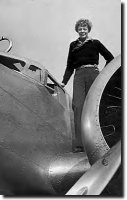
Her Travels
Charles Lindberg made his record breaking trip across the Atlantic Ocean in the year 1927. This inspired Amelia to become the first woman to fly across the Atlantic Ocean. At first, Earhart joined Wilmer L. Stutz and Louis E. Gordon in their bright red Fokker F.VII named the Friendship on their 2,000-mile (3,219-kilometer) trip to Wales on 4 June 1928. Earhart had no part in piloting the plane during the 20-hour, 40-minute trip and was, in her words, "just baggage," making her even more eager to cross the Atlantic on her own.
On 20-21 May 1932 Amelia accomplished her goal of flying across the Atlantic Ocean Solo. She took off from Newfoundland, Canada, at 7:12 p.m. on May 20, in her Lockheed Vega. Her flight was filled with dangers, from rapidly changing weather to a broken altimeter so she could not tell how high she was flying, to gasoline leaking into the cockpit. At one point her plane dropped almost 3,000 feet (914 meters) and went into a spin (which she managed to pull out of) and flames were shooting out of the exhaust manifold. She brought her plane down on the coast of Ireland after a harrowing trip lasting 15 hours and 18 minutes The flight was the second solo flight across the Atlantic and the longest nonstop flight by a woman--2,026 miles (3,261 kilometers)--as well as the first flight across the Atlantic by a woman. President Herbert Hoover awarded her the National Geographic Society Medal on June 21, 1932, for her achievement, and the U.S. Congress awarded her the Distinguished Flying Cross, the first woman to receive such an honor.
Earhart's accomplishment meant a great deal to the entire world, but especially to women, for it demonstrated that women could set their own course in aviation and other fields.
This lead to all her other travels such as a solo long-distance flight over the Pacific Ocean, flying from Honolulu, Hawaii, to San Francisco, California. This complicated flight in her second Lockheed Vega occurred in adverse weather conditions and demonstrated Earhart's courage as well as her stubbornness.
She followed that flight with two more first solo flights--one on April 19-20 from Los Angles, California, to Mexico City, in 13 hours, 23 minutes and the second on May 8, 1935, from Mexico City to Newark, New Jersey, in 14 hours, 19 minutes.
Amelia Earhart wanted to be the first person to fly around the world at its widest, close to the equator. Her first attempt at the world flight began on March 17, 1937, in Oakland, California, but ended abruptly with a runway crash in Honolulu, Hawaii, after a tire blew and a shock absorber on the landing gear failed. Earhart decided to repair the damaged plane and try again.
The flight began again on May 20, 1937, this time heading from Oakland to Miami, Florida. But it was plagued with mechanical problems along the way that resulted in further delays. Eventually she and Fred Noonan, her navigator, reached Miami and made final adjustments to the plane's engines and instruments. Finally, Earhart and Noonan were ready to depart.
What turned out to be the final flight of Earhart's career, and, ultimately, her life, began on June 1, 1937. Earhart and Noonan left for their round-the-world flight from Miami, Florida, in her twin-engine, red-winged Electra. From Miami, they flew to San Juan, Puerto Rico. Right before taking off on this leg of the flight, Earhart was quoted as saying, "I have a feeling there is just about one more good flight left in my system and I hope this trip is it. Anyway, when I have finished this job, I mean to give up long-distance 'stunt' flying."
Their next destination, and the most dangerous stop of the trip, was Howland Island, a tiny island in the Pacific Ocean, 2,556 miles (4,113 kilometers) away. Before Earhart took off from Lae on July 1, there was confusion about which radio frequencies were to be used, which remained unresolved before she took off. As the scheduled time neared for Earhart to approach the island, several transmissions were received from her, demanding to know the weather. A new weather report describing heavy clouds and rain northwest of Howland had been issued, and Earhart had apparently run into the storm.
Earhart transmitted several more times but never reached her destination, disappearing somewhere off the coast of the island. A large search party was quickly organized, but no remains of the crew and the plane were ever found.
All search was unsuccessful and there was no evidence found. Two theories, though, emerged; disappearance and crash and sink theory. Although Amelia Mary Earhart was at a young age of 39 when she went missing, she is an excellent role model for women all over the world.


 Her Travels